tochat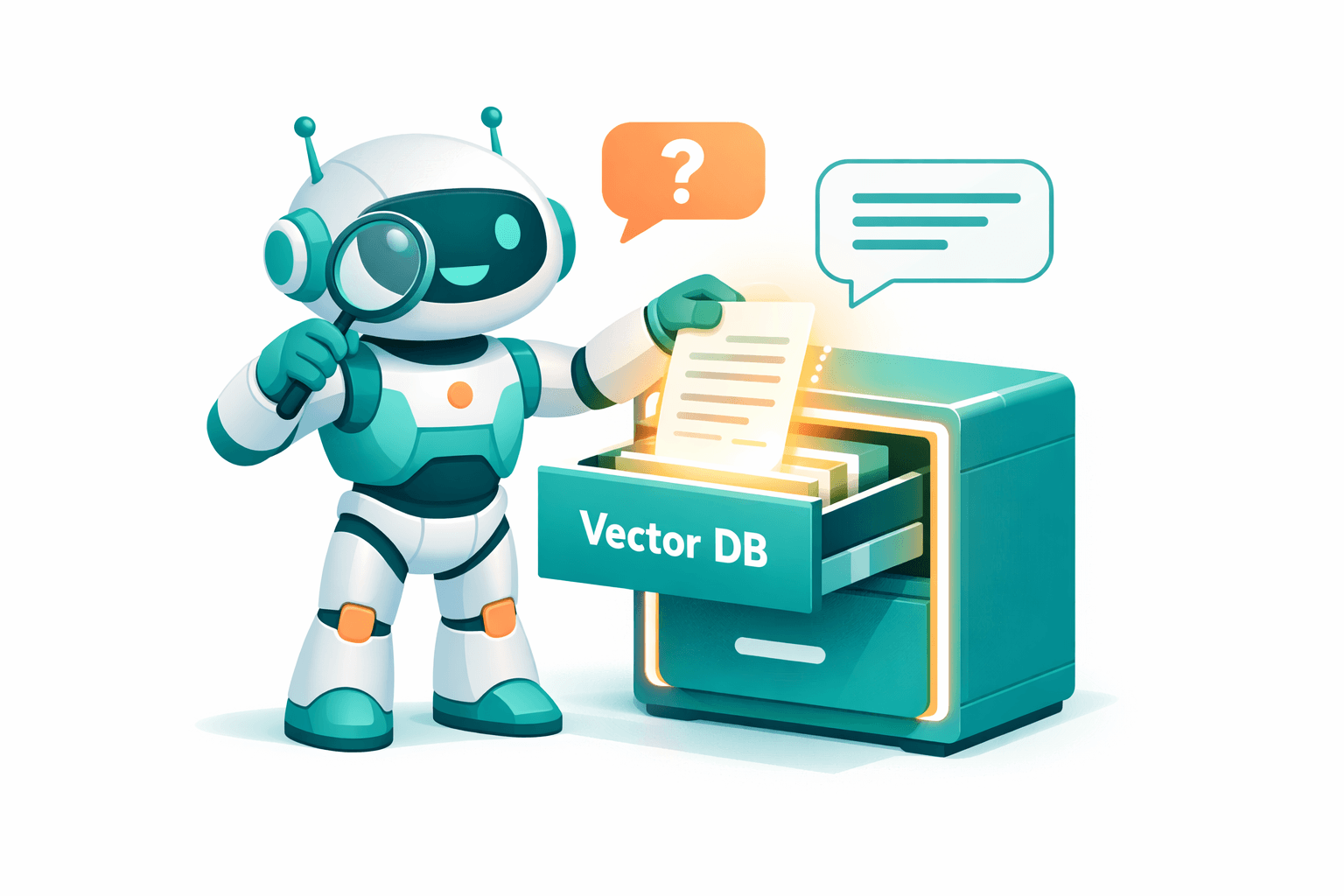
As AI agents become a mandatory tool for modern businesses, a specific acronym keeps popping up in tech circles. If you are looking to build a chatbot that actually knows your business, you might be asking: what does RAG stand for, and why is it so important?
In this guide, we are going to break down the theory and concept behind RAG. We will look at the technical terms—like vector databases and embeddings—and explain them in plain English so you can understand exactly how modern AI gets its “memory.”
The Core Question: What Does RAG Stand For?
RAG stands for Retrieval-Augmented Generation. It is an AI framework that improves the quality of an AI’s response by grounding the model on external sources of knowledge.
To understand why we need it, you have to understand the core problem with standard Large Language Models (LLMs) like ChatGPT or Google Gemini:
- The Knowledge Cutoff: LLMs are trained on a massive snapshot of the internet, but that knowledge stops at a certain date. They don’t know what happened yesterday, and they certainly don’t know your company’s proprietary return policy.
- Hallucinations: When an LLM doesn’t know an answer, it has a bad habit of confidently making one up (hallucinating).
Retrieval-Augmented Generation (RAG) solves this. Instead of letting the AI guess based on its general training, RAG forces the AI to “Retrieve” specific data from your private documents, and then use that data to “Augment” the “Generation” of its answer.
“Think of a standard LLM as a brilliant student taking a closed-book exam. Think of an LLM with RAG as that same brilliant student taking an open-book exam, where you provided the textbook.”
How RAG Works: The Technical Concepts Simplified
When you upload a PDF to a platform like Tochat, a fascinating, complex process happens behind the scenes. Here are the technical concepts explained simply:
Chunking and Embeddings
When you give an AI a 50-page PDF, it doesn’t read it like a human does. First, the system breaks the document down into smaller pieces called Chunks (usually a few paragraphs each).
Next, it converts the text in those chunks into numbers. This process is called creating Embeddings. It maps the meaning of the words into a multidimensional coordinate system. For example, the words “dog” and “puppy” would have coordinate numbers very close to each other because their meanings are related.
The Vector Database (Vector DB)
Once your document is turned into thousands of numerical coordinates (embeddings), those numbers need a place to live. Standard databases (like SQL) are built for rows and columns. They are terrible at storing and searching multi-dimensional numbers.
This is where a Vector DB comes in. A Vector Database is essentially a highly specialized, futuristic filing cabinet designed exclusively to store these numerical representations of meaning.
Semantic Search
When a user visits your website and asks your AI agent, “How do I get a refund?”, the RAG system kicks in:
- It turns the user’s question into an embedding (numbers).
- It looks inside the Vector DB to find the chunks of your PDF that are numerically closest to the user’s question. This is called Semantic Search—it finds answers based on meaning, not just exact keyword matches.
- It pulls that specific paragraph out of the database.
The Final Generation
Finally, the system sends a hidden prompt to the AI (like Google Gemini) that looks something like this:
“You are a helpful assistant. The user asked: ‘How do I get a refund?’ Based ONLY on this retrieved text: [Insert the paragraph pulled from the Vector DB], answer their question politely.”
Bringing It All Together with Tochat
Understanding what does RAG stand for is great for theory, but building the chunking pipelines, embedding models, and vector databases from scratch is incredibly difficult and expensive.
That is why we built Tochat. We handle the entire RAG pipeline invisibly in the background. When you drag and drop a PDF into the Tochat dashboard, we instantly chunk, embed, and store it in our secure Vector DB. When a user asks a question, your Gemini-powered agent uses RAG to retrieve the perfect answer instantly.
Now that you understand the theory of RAG and how Vector Databases give AI a flawless memory, it’s time to put it into practice. If you want to see how easily you can implement this technology for your own business, check out our comprehensive guide on step by step creating an AI agent: the hard way vs. the Tochat way.